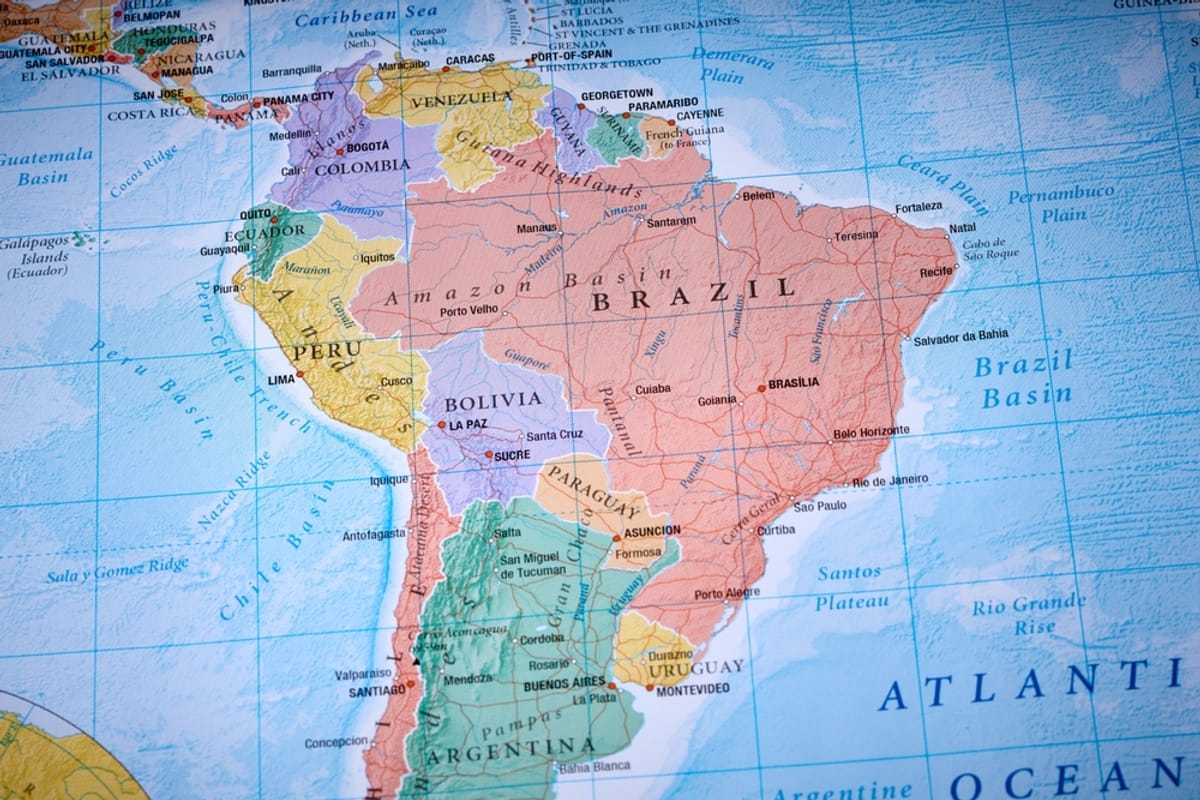
This region is predicted to see GDP growth of 2.2% to 2.9% in the 4th quarter of 2026.
The 12 countries that constitute South America will have a combined construction market of $650 billion to $850 billion in 2026. Many South American countries have received government funding / stimulus grants related to new infrastructure projects in the last 12 to 18 months.
South America’s construction sector remains somewhat stable and will experience minimal growth as we move into the 4th quarter of 2026. South America’s construction forecast for 2026 is reasonably positive, with unbalanced growth in some countries, propelled by infrastructure, roads, bridges, energy-related facilities, and new AI-related data centers.
South American inflation was gradually moderating prior to February 28, 2026, the start of the Iran conflict between Iran, Israel, and the USA. Future inflation risks and challenges include volatile currencies and a lengthy Iran conflict that could drive energy, steel, aluminum, copper, construction components, wage rates, and freight costs significantly higher.
Venezuela recently announced that it would reactivate / refurbish as many as 250 oil and gas drilling rigs to boost future oil and gas production. This effort could generate as many as 3,000 new jobs and could boost daily production to more than 1.7 million barrels of oil per day.
Many CAPEX refinery projects are set to commence in the 2nd half of 2026. These initial projects will be concentrated on Revamp / Rehab / Modernization / De-Bottlenecking projects in the neglected domestic refining sector. These production and infrastructure facilities are basically worn out and are not capable of producing Venezuela’s potential production of 3.5 million barrels a day. A number of U.S. and international oil companies are committed to working on future projects.
Brazil continues to be economically the #1 country in South America, while other countries such as Argentina, Uruguay, Colombia, and Chile are set to see an increase in construction activity in the 2nd half of 2026.
Brazil’s construction market is forecast to grow by 3.2% to 3.7% in the 2nd half of 2026. Brazil’s left-leaning President is said to be wary of the U.S. Trump administration. Brazil continues to develop its bountiful offshore oil and gas, timber, crops, ethanol, hydroelectricity / energy, and aircraft production.
Brazil is Latin America’s largest economy. It is a member of BRICS. It will be interesting to see the reaction of Brazil’s left-leaning government to the U.S. administration. The Brazilian construction sector is estimated to be a $110 billion to $170 billion market in2026, which is 5% to 6% of Brazil’s GDP.
Argentina is experiencing a major improvement in its construction inflation rate, which isnow in the 20% to 35% range. This improvement is the result of a newly elected government. Argentina still has aspirations of taking over the Falkland Islands, which could be an issue in the next couple of years.
Chile and Colombia are both experiencing reasonably high inflation rates as we move further into 2026, and unfortunately, this will impact construction costs and future construction activity. A possible conflict with the U.S. is possible, with the U.S. Navy destroying a number of so-called “drug” vessels in the last month or two.
The smaller nations of South / Central America and the Caribbean, such as Bolivia, Peru, Paraguay, Ecuador, Panama, the Dominican Republic, and Jamaica, are challenged by high unemployment levels, inflation, and rising costs of construction-related materials.
Construction-related bulk materials and equipment such as copper (wire / pipe), structural steel, rebar, piping (PVC, CS & SS), lumber / plywood, windows, doors, and instrumentation devices are starting to moderate in most countries.
The #1 question for the South American construction sectors is how long the Iran conflict will last and whether it will drive up inflation in the next three to six months.